Come to the inaugural McGillis School Art Show, and see hundreds of pieces of artwork by McGillis students. Exhibit will run from Tuesday, May 10 through Friday, May 13, 2011. Enjoy the art show anytime during the exhibition, and attend one of the special events listed below.
Gallery Opening: Tuesday May 10th at 7:00 pm
Attend the premier of the 2011 Mcgillis School Art Show! Stroll the exhibit while enjoying drinks and appetizers (grown-ups only please).
Family Night: Wednesday, May 11th from 5:30- 7:30 pm
This is a casual, drop-in evening and an opportunity for McGillis students to personally show you their artwork. Cookies and juice will be served in the dining hall.
April 29, 2011

April 28, 2011
"42 Ways to Not Make Trash"
Check out this interesting article from 'Yes! Magazine:
(For the first article visit www.yesmagazine.org)
(For the first article visit www.yesmagazine.org)
42 Ways to Not Make Trash
Taking what he learned from his experiment, No Impact Man Colin Beavan offers 42 tips to move toward a zero-waste lifestyle.
posted Apr 22, 2011
Together with his family, Colin Beavan—aka No Impact Man—spent a year trying to live in the middle of New York City without having a negative impact on the environment. One of his first challenges: getting through everyday life without producing trash. Below are some of his favorite tips and tricks.

- No soda in cans (which means we’re probably less likely to get cancer from aspartame).
- No water in plastic bottles (which means we get to keep our endocrines undisrupted).
- No coffee in disposable cups (which means we don’t suffer from the morning sluggishness that comes from overnight caffeine withdrawal).
- No throwaway plastic razors and blade cartridges (I’m staging the straightedge razor comeback).
- Using non-disposable feminine-hygiene products that aren’t bad for women and are good for the planet.
- No Indian food in throwaway takeout tubs.
- No Italian food in plastic throwaway tubs.
- No Chinese food in plastic throwaway tubs.
- Taking our own reusable containers to takeout joints (except that now we’re eating local so this tip is out for us).
- Admitting that we sometimes miss Indian, Italian and Chinese takeout.
- Hopping on the scale and celebrating the loss of my 20-pound spare tire since I stopped eating bucketsful of Indian, Italian and Chinese takeout.
- Buying milk in returnable, reusable glass bottles.
- Shopping for honey and pickled veggies and other goods in jars only from merchants who will take back the jars and reuse them.
- Returning egg and berry cartons to the vendors at the farmers’ market for reuse.
- Using neither paper nor plastic bags and bringing our own reusable bags when grocery shopping.
- Canceling our magazine and newspaper subscriptions and reading online (you can still make a donation to support the media organizations you value).
- Photo by the camera is a toy.
- Carrying my ultra-cool reusable cup and water bottle (which is a glass jar I diverted from the landfill and got for free).
- Carrying reusable cloths for everything from blowing my nose to drying my hands to wrapping up a purchased bagel.
- Wiping my hands on my pants instead of using a paper towel when I forget my cloth.
- Politely asking restaurant servers to take away paper and plastic napkins, placemats, straws, cups and single-serving containers.
- Explaining to servers with a big smile that I am on a make-no-garbage kick.
- Leaving servers a big tip for dealing with my obsessive-compulsive, make-no-garbage nonsense, since they can’t take the big smile to the bank.
- Pretending McDonalds and Burger King and all their paper and plastic wrappers just don’t exist.
- Buying no candy bars, gum, lollypops or ice cream (not even Ben and Jerry’s peanut butter cup) that is individually packaged.
- Making my own household cleaners to avoid all the throwaway plastic bottles.
- Using baking soda from a recyclable container to brush my teeth.
- Using baking soda for a deodorant to avoid the plastic containers that deodorant typically comes in (cheap and works well).
- Using baking soda for shampoo to avoid plastic shampoo bottles.
- Using the plastic bags that other people’s newspapers are delivered in to pick up Frankie the dog’s poop.
- Keeping a worm bin to compost our food scraps into nourishment that can be returned to the earth instead of toxins that seep from the landfills.
- Switching to real—meaning cloth—diapers which Isabella, before she was potty-trained, liked much better.
- Not buying anything disposable.
- Not buying anything in packaging (and count the money we save because that means pretty much buy nothing unless it’s second hand).
- Shopping for food only from the bulk bins and from the local farmer’s market where food is unpackaged and fresh.
- Forgetting about prepackaged, processed food of any description.
- Being happy that the result is that we get to eat food instead of chemicals.
- Giving our second-hand clothes away to Housing Works or other charities.
- Offering products we no longer need on Freecycle instead of throwing them away.
- Collecting used paper from other people's trash and using the other side.
- Using old clothes for rags around the apartment instead of paper towels.
- Talking with humor about what we’re doing because making a little less trash is a concrete first step everyone can take that leads to more and more environmental consciousness.
April 27, 2011
From the Mailbox: UMNH Summer Camps
This summer the Utah Museum of Natural History has some fantastic camps lined up! Here's the scoop:
 Photo Credit
Adventures in the Natural World: Summer Camp 2011
This will be the final year of summer camps at the Museum's current building on Presidents Circle, with new camps and themes for Kindergarten through 7th grade children.
Weeklong camps are led by experienced instructors trained to teach in informal learning environments. Camps run weekly June 6 through August 12.
Each camp is designed to capture the attention and interest of your child and is targeted for the grade your child will attend in Fall 2011.
Sign up for a summer camp to explore the natural world, conduct scientific experiments, become familiar with key STEM concepts, work with Museum artifacts and animals, participate in hands-on science activities, and get outdoors!
For more information like class descriptions and schedules, or to register online, visit www.umnh.utah.edu/summer.
April 20, 2011
Environmental Education Week Ends (but EE lives on)!
To commemorate the end of Environmental Education Week and to usher in Earth Week, the Living Planet Aquarium courteously provided some great ocean facts (and we decided to add some extra fun). As you are aware, EE Week focused upon oceans and our relationship to them, so, enjoy these exciting tidbits of which you might not have been previously aware. Thanks TLPA!


Here's the Fisheries Science Wikipedia Page
- Did you know that a tsunami is a usually caused by an earthquake, volcanic eruption or coastal landslide and is a large ocean wave that can travel at speeds up to 600 mi/hr?! Most tsunamis happen in the Pacific Ocean, but can occur in any body of water.Here's a somewhat sensationalistic, but powerful video from CBS News showing some of the effects of the recent Tsunami that swept into North-East Japan.
- Did you know that scientists are now looking to our oceans to help solve the problems of climate change? For instance, windmill blades are now being manufactured to mimic the fins of humpback whales in order to increase efficiency.
- Did you know that if you like fishing you could turn it into a career by becoming a fishery scientist? Fishery scientists do things like tag sharks and monitor their movements. They also help come up with alternative methods for harvesting seafood and monitor fish populations.
Here's the Fisheries Science Wikipedia Page
- Did you know that about 25% of the creatures in the ocean live in coral reefs? There are 5,000+ species of fish alone living in coral reefs! Scientists consider coral reefs to be the “rainforests of the ocean.”
- Did you know that most of the water that Utah receives as precipitation (rain, snow, sleet and hail) originally comes from the Pacific Ocean? That means that your water could have been the same water a Great White Shark swam through!


April 19, 2011
Mark Miller Subaru's LEED Building and Do Good Feel Good Event!
 To get ready for the upcoming Grand Opening Community Event at Mark Miller Subaru Midtown, USEE staffer Marta Nielsen took a tour of their new LEED building. For details about the community event, scroll to the end of the post!
The building that now houses Mark Miller Subaru Midtown has been around for awhile. It started as a Buick dealership 40 years ago, but lately has been transformed into a LEED certified building that will pay for itself in less than ten years. The dealership used the existing building, changing a few details to make it more sustainable, and also built a new addition to meet the needs of the growing business.
It takes a keen eye to recognize the green features of the reused building, but fortunately there are educational signs in plain sight that detail a few of the features. Staff at the dealership is also very helpful in answering questions, I even recruited the General Sales Manager to give me a tour. Here are some highlights:
 W
W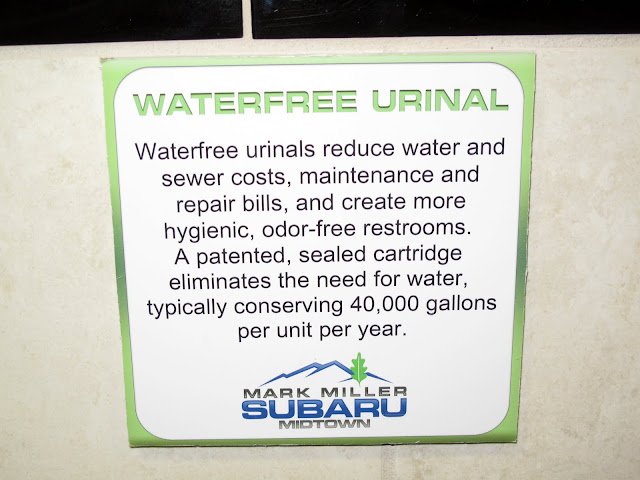 ater: Not only do the bathrooms in the retrofitted building use dual flush toilets and waterless urinals (which alone conserve 40,000
 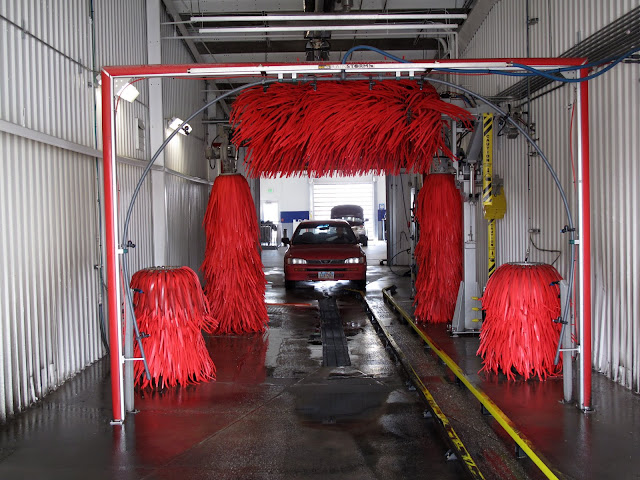 gallons each year), but the car wash uses 75% recycled water. Landscaping around the building is watered with groundwater that would normally be pumped into the sewer system.
- Lighting: To optimize natural lighting and minimize electricity use, the Mark Miller Subaru Midtown building uses high-tech skylights, compact florescent bulbs, and and sensors that automatically raise and lower the interior lights depending on the amount of natural light available. In the car lot, existing lamp posts were retrofitted with new heads that use florescent bulbs. These lights are on a timer, coming on just before sunset, and shutting off at midnight to conserve electricity.
- Reducing Waste: All of the waste from the renovation and construction were recycled, and inside the Mark Miller Subaru Midtown you will see recycling bins next to every garbage.
 The tile in the new building is made with 65-85% recycled materials, and the exterior of the building is covered with 85% recycled aluminum. In the retrofitted part of the building, the existing flooring and windows were preserved to minimize waste. Dyson hand dryers in the bathrooms not only cut the use of paper towels, but use 80% less energy than most hand dryers.
 - Customer's Appreciation: Customers love the new building, and show their appreciation for Mark Miller Subaru's commitment to sustainability by supporting the business. As my tour guide said, "LEED sells cars." The
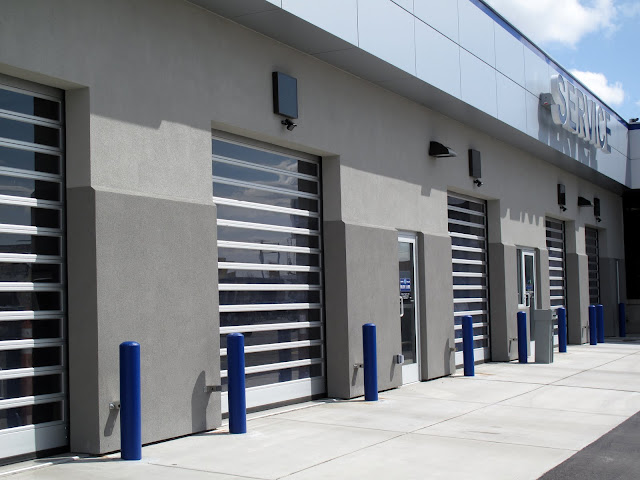 LEED building is comfortable, with high-speed shop doors and a newly insulated roof keeping keeping the temperature inside more enjoyable. A cafe inside the dealership not only provides customers and employees with a convenient place to grab a bite to eat, but decreases the overall carbon footprint as those customers and employees stay on-sight rather than driving somewhere else for lunch.
All of this will be leading up to the Grand Opening Community Day Event, where you can come and celebrate Mark Miller Subaru's new LEED certified building as well as local nonprofits. Mark Miller Subaru will personally donate $13,000 per charity plus the money raised during the Do Good Feel Good Event.
The Grand Opening Community Day Event will take place on Saturday May 7 at the Midtown location. In addition, Mark Miller Subaru will be offering special pricing when you mention the DO GOOD, FEEL GOOD event. Feel good when you purchase your car knowing you are buying from one of the most ethical dealerships in the nation.
April 18, 2011
Earth Day: A few questions for Fred Montague
From FYI, the newsletter for faculty and staff of the University of Utah, an interview with 2010 Utah Environmental Education Conference Keynote Speaker Fred Montague. Find the original article here.

Fred Montague
Earth Day is April 22. For more than forty years, people around the world on this date have participated in conscious actions to honor the Earth. We asked Emeritus Professor of Biology Fred Montague to share his views on Earth Day.
FYI News: Why is it important to celebrate Earth Day?
Fred Montague: For an immature and reckless society, the annual Earth Day observance is an important prelude to the daily practice of joyful sustainable living that is characteristic of a more mature and secure society that understands that everyday is Earth Day.
FYI: What is your biggest concern for the planet today? Montague: The problem is one of human perception. In my view, there is nothing wrong with the planet–as the common term “environmental crisis” might imply. What has happened is that we have fostered a society whose economic and self-promotional activities have resulted in impacts on the environment. Until we reform the culture’s goals and the means to those goals we will continue to squander exhaustible resources, use renewable resources faster than they can regenerate, evict species from the Earth at rates 1,000 times faster than natural extinction rates, contaminate our living space beyond the environment’s capacity to process the pollution, change the relatively benign global climate, and in general create by our own actions a diminished future for ourselves and our children.
The Earth will still be spinning long after our species has taken its place in the history of the rocks. The real question is whether modern humans can protect the conditions on Earth that called them into existence and that enable them to live and thrive, laugh, learn, love, and play. This is mostly a matter of ethics and justice and education—education much different than what we call it today.
FYI: When you look back on the first Earth Day in 1970 and compare it with today, where are we making progress and where are we falling short?
Montague: Since 1970 in the U. S., citizens have forced corporate and political “leaders” to take the lead out of gasoline, to attempt to regulate ozone-depleting chemicals, to protect breathable air and drinkable water, and to protect wild species that might be in the path of human “progress.” At a few times it almost seemed possible that we could have added “safe environment” to the “Bill of Rights.”
We are falling short in reaching a universal understanding of our ultimate dependence on earth-based ecological processes and functions. We do not all understand, even as a literate and educated society (e.g. Americans), that there are limits to exploitation and that if we transcend those limits, there are usually unintended and harsh consequences. When we ignore the limits, we temporarily create an American false prosperity by using other countries’ resources, by exporting our pollution into the global commons, and by changing and degrading our grandchildren’s world. In other words, our material prosperity is taken from other people, from the Earth, and from the future.
FYI: How have your own views changed since 1970?
Montague: They haven’t changed. They have only been reinforced by scientific evidence, by demographic observations, by economic and consumption statistics, and by taking a walk through almost any city or landscape.
FYI: Of all the many facets associated with Earth Day (e.g. conservation, climate change, alternative energy, sustainability, recycling, green building, planting trees, etc.) what areas are most critical?
Montague: What are commonly referred to by their apologists as “pure capitalism” and the “free market” must be recognized for what they are. The adjectives are incorrect. I’m not an economist, but you don’t need to be a botanist to recognize a rotten apple. Every single parenthetical “facet” listed in the question would instantaneously be addressed and resolved if the “market” told the truth and did not externalize (defer) the costs of products and processes. For example, if just the costs of air pollution and climate change impacts (e.g. sea level rise, agricultural disruption, human health issues, etc.) were factored into the cost of our energy purchases, a gallon of gasoline would cost about $1,200, and a kilowatt of coal, natural gas, or nuclear electricity would cost about $180. There must be full disclosure of real costs and the subsidies and penalties that enable a dysfunctional and dangerous system to persist. On the other hand, if the values of life-enabling ecological functions (services of “Nature”) were fully accounted for, they would be instantaneously and universally protected.
As for the “capitalism” part, ask Jesus.
We must get to the root of the problem by asking thoughtful, difficult, and critical questions about “business as usual.” Otherwise we will recycle a few cans, plant a tree at city hall, and be asking these same questions on Earth Day’s 50th anniversary.
FYI: How do you change people’s behavior?
Montague: All conscious people embrace a world view—their core values and beliefs about how the world “works.” and about what their role in the world should be. Worldviews are implanted in people by their families, by their culture, and by their own learning and discovery. Many people either don’t understand that there are other worldviews or they discredit out-of-hand worldviews that contradict theirs. All worldviews are based on various assumptions. Many assumptions don’t fit the ecological context anymore. An honest evaluation of the assumptions underlying one’s beliefs is the starting point.
FYI: Who are our best role models?
Montague: For 99.9 percent of our 200,000-year history on Earth, we humans lived by the natural productivity of the Earth’s landscapes and seashores, and we lived, by necessity, within their environmental constraints. We are not the descendents of those who “over-lived” their surroundings. Today, however, with powerful technology and arrogant stories or worldviews, we appear to have chosen to “over-live” the Earth. In our modern times, our best role models are those folks who, by choice, live rich and fulfilling lives by giving back to the landscape more than they take. They use appropriate technology for appropriate reasons at appropriate times. Wherever people do this, we have role models.
FYI: If you could give everyone an assignment to do on behalf of the Earth, what would it be?
Montague: Plant a garden. While you are tending your garden, outline your worldview and list all of the assumptions upon which it is based. Once you have honestly done this, your path will become more and more obvious—and the polar bears and the wildflowers and the children will thank you.
FYI: Who are your conservation heroes?
Montague: To mention just a few of the many: Aldo Leopold, Rachel Carson, Edward Abbey, Wendell Berry, Marjory Stoneman Douglas, Lester Brown, John Muir, Henry David Thoreau, Wallace Stegner, Pete Seeger, Henry Beston. . . .
FYI: Name three books you think everyone should read in order to gain a better education and understanding of the situation.
Montague: Aldo Leopold’s A Sand County Almanac: with Essays on Conservation from Round River (read first the essay “The Land Ethic”); Ivan Illich’s Tools for Conviviality; and Lester Brown’s World on the Edge: How to Prevent Environmental and Economic Collapse (a free download). A fourth possibility is an obscure quirky book titled Gardening: An Ecological Approach (to individual, community, and global health). See Mountain Bear INK online.
FYI: How will you celebrate Earth Day this year?
Montague: In Barbara Kingsolver’s words, by trying to “be a good animal today.”
Check out Fred Montague’s website at Mountain Bear Ink. He also has an article in the April issue of Catalyst magazine on why the size of raised garden beds matters—practical advice indeed!
April 15, 2011
Persuing Zero Waste
Momentum Recycling, a USEE Member, compiled a great list of suggestions for lowering your waste output. Some suggestions are from their own clients!
__________
From Momentum Clients
· Stop using paper towels and use rags/microfiber towels instead. (Mary Jacquin, Rowland Hall St. Marks);
· Buy local, organic fruits and vegetables from farmers’ markets to cut down on packaging. (anonymous);
· Compost your green waste or, if your community has one, use the municipal brown bin for your green waste. (anonymous)
· Buy food in bulk. (anonymous)
· Take durable, reusable containers with you to restaurants for leftovers. (Crystal Frost, 3-form)
_________
From “Zero trash family lives without clutter, excess” (USA Today) and the “Zero Waste Home” Blog
· Buy goods with minimal packaging and make sure the packaging can be recycled.
· Bring glass jars, fabric bags, and canvas totes when you shop at super markets.
· Eliminate garbage bag liners and use either stainless steel or glass reusable containers instead of sandwich/Ziplock bags.
· Learn to love tap water (avoid purchasing water).
· Use bulk castile soap as a dish/hand cleaner, baking soda as a scrubber with a compostable cleaning brush (a wooden one with natural hair). Choose dishwasher detergent in a cardboard box.
· Turn your trash can into a big compost keeper. Use your tiny compost keeper as a trash can (on the market, the sizes for these seem to be reversed).
· Reinvent your leftovers before they go bad. Go thru your recipes and only keep the recipes that can be achieved with zero waste in mind.
· Refill your bottles with bulk shampoo and conditioner.
· Use ceramic dishes, cloth dinner napkins and cloth appetizer napkins at all times.
· Give the gift of an experience as a birthday present.
What do YOU do to strive for zero waste?
April 14, 2011
Member Highlight: Utah Museum of Natural History


USEE staffer Marta Nielsen shares insights into the Utah Museum of Natural History’s new facility from a tour with School Programs Director (and USEE Board President) Madlyn Runburg
If you have driven up by Red Butte Gardens or been on the Bonneville Shoreline Trail lately, you’ll have seen it: the beautiful new building near completion for the Utah Museum of Natural History. While the exhibits inside are still being installed, and the collections are being prepped for display, Utah’s natural environment is showcased in the building design, inside and out.
Outside the Museum

To represent the geological and mineralogical history, the exterior of this building is banded with three different copper alloys, which will each develop a unique and beautiful patina over time. The exterior not only harmonizes with the foothills on which the building sits, but visually emulates geological stratification and landforms. There are also social spaces featured on outside of the building like patios and seating for the Museum café offer visitors beautiful views of the Salt Lake Valley.
 T
T here are also multiple outdoor learning spaces like learning terraces outside of the galleries. A favorite is sure to be the terrace off of the Native Voices gallery which includes an amphitheater with seating for up to 100 people. Of special note to the energy curious visitor is the sky terrace that overlooks the rooftop. The roof, covered with white reflective material (to increase albedo), will include arrays of solar panels and landscaping. Another green feature of this project are the parking lots leading up to the new building. They aren’t your typical asphalt, but permeable. This feature allows for natural drainage, and will hopefully be one of many aspects that will allow the Museum to achieve LEED Gold certification. In addition to the many sustainable building features, Museum supporters have successfully preserved the Museum site’s oak grove through a protective easement.
Interior Design
 En
En nead Architects and Gillies Stransky Brems Smith are the lead architects for the new building, and while the final design is nothing short of inspired, the process used to create the vision was equally intriguing. To communicate the importance and purpose of the UMNH, the architects were taken on a series of road trips across the state. This enlightening experience is what inspired the copper banding and stratification, as well as an interior “canyon” and triangulated walls throughout the building that suggest faulting. The design of the building embodies so perfectly the natural landscape of Utah that I felt as much at home there as in Arches, Bryce, or Canyonlands.
 The new exhibit space will showcase Museum objects, with carefully designed zones featuring different aspects of natural history in a way that integrates key themes that cross cut multiple areas of science. In the Past Worlds exhibit, Museum patrons will be able to walk among dinosaurs, gaining different perspectives on the fossilized remains. Another area, Our Backyard, designed for small children, recreates a backyard, complete with trees, a garden, a stream, and tunnels for little ones to crawl through, making it clear that nature doesn’t have to be a faraway place, but can be out our own backdoor. Inside the Museum is a replica of an archeological dig site, which will be interactive and fun for visitors of all ages. Careful humidity controls inside the changing exhibits gallery will allow traveling exhibits that haven’t been able to come in the past, due to our dry climate, to make an appearance at the new building.
Museum Community
 The Museum is truly built to optimize educational opportunities for the community. There are several learning labs within the new building that can be used for formal classes taught by Museum staff, or for impromptu lessons in natural history that any Museum visitor can engage in. Large windows in the Paleontology Prep Lab will allow visitors to see firsthand the amazing science that often occurs behind closed doors.
 There is also a Community Room that will be used for a variety of functions including community meeting needs. Other larger spaces will be ideal for banquets or conferences. This new facility is more than just inspired design and stunning valley views, more than just a newer, bigger building; it will truly facilitate better environmental education as the Museum continues its extensive research and shares that work with the public.


For more information and photos of the new Utah Museum of Natural History, visit umnh.utah.edu/newmuseum. All photos here from UMNH photo gallery.
April 11, 2011
Environmental Education Week Begins!
Today, Environmental Education Week officially begins. Taking place from April 10-16 and in anticipation of upcoming Earth Day, EE Week encourages K-12 teachers and students (along with everyone else) to promote and practice ways of learning through and with the environment.
This year's theme is "Ocean Connections." Though Utah may not border any ocean, these large bodies of water affect the planet, and us, spectacularly. For instance, oceans generate most of the oxygen (about 70% total) on the planet. Oceans are helping us all to breathe. We also affect oceans, for about 80% of all plastic in the oceans comes from trash that has been washed from land into the sea. This plastic accumulates in oceanic gyres, where currents come together and collide; the largest plastic "oceanfill," aka the "Great Pacific Garbage Patch," is twice the size of Texas.
According to the National Environmental Education Foundation (NEEF), the group that runs this event, "When you register for EE Week, you will join a national network of educators dedicated to increasing the environmental literacy of K-12 students. You will also receive:
throughout the country.

This year's theme is "Ocean Connections." Though Utah may not border any ocean, these large bodies of water affect the planet, and us, spectacularly. For instance, oceans generate most of the oxygen (about 70% total) on the planet. Oceans are helping us all to breathe. We also affect oceans, for about 80% of all plastic in the oceans comes from trash that has been washed from land into the sea. This plastic accumulates in oceanic gyres, where currents come together and collide; the largest plastic "oceanfill," aka the "Great Pacific Garbage Patch," is twice the size of Texas.
According to the National Environmental Education Foundation (NEEF), the group that runs this event, "When you register for EE Week, you will join a national network of educators dedicated to increasing the environmental literacy of K-12 students. You will also receive:
- Certificates of Participation;
- Monthly e-newsletters packed with EE resources and opportunities for educators;
- Access to an online library of environmental curricula and resources;
- An opportunity to participate in EE Week's webinars for educators; and
- Discounts and special offers on educational materials."
throughout the country.
Below, you'll see some of the suggestions NEEF has provided in order to participate this week. Jump on in; the water's fine!

April 6, 2011
Earth Day Resource from the EPA
 Image Source
With only two weeks before Earth Day 2011, we thought we'd share a few more resources with you to help you prepare.
The EPA has come out with an online resource packet all about green schools, with information not only on how to become a green school but also how to educate students about being green. To check out the 2011 E-Packet, click here!
The EPA has come out with an online resource packet all about green schools, with information not only on how to become a green school but also how to educate students about being green. To check out the 2011 E-Packet, click here!
Earth Day: Pick 5
Sent to us from the US EPA.
Pick 5 for YOUR environment!
Environmental action can mean doing different things in different places, but it begins by taking the simple steps where you live. Doing your part means doing what you can do. By choosing five or more of these ideas and sharing your own, you are joining thousands of others who are doing the same. Together we can make the biggest difference, so make your actions count today!
http://www.epa.gov/pick5/
What 5 will you pick?
Pick 5 for YOUR environment!
Environmental action can mean doing different things in different places, but it begins by taking the simple steps where you live. Doing your part means doing what you can do. By choosing five or more of these ideas and sharing your own, you are joining thousands of others who are doing the same. Together we can make the biggest difference, so make your actions count today!
http://www.epa.gov/pick5/
What 5 will you pick?
April 5, 2011
From the (e)Mailbox: Earth Day Resources
We thought we'd pass this info on from the Education Team at the Earth Day Network
As Earth Day approaches, the Earth Day Network is stepping up their efforts to reach out to educators to share our environmental education materials, as well as some Earth Day specific resources, with the hope of facilitating as many Earth Day teaching moments as possible. Check out the links below.
- The K-12 Earth Day Action Map is an Earth Day activities idea-sharing platform that plots how students and educators are supporting our environment by celebrating Earth Day.
- The K-12 Guide to Educating on Earth Day has tips, activity ideas, and resources for administrators, teachers, students, and parents who want to become involved in Earth Day.
- Our Education Page has hundreds of high quality environmental lesson plans for a diverse range of subject areas, grade levels, and environmental issues in addition to hundreds of pages of school greening instructions.
- Teachers can email education@earthday.org to request specific lesson plans or instructions.
- Our printable Earth Day Flier can be used to promote Earth Day activities in schools.
April 4, 2011
Help Mark Miller Subaru Help USEE!

“DO GOOD, FEEL GOOD” TO HELP OUT THE UTAH SOCIETY FOR ENVIRONMENTAL EDUCATION
Mark Miller Subaru South Towne (10920 South State Street) and Midtown (3535 South State Street) have partnered with six local non-profits to give back to the community. For the Month of April, during their “DO GOOD FEEL GOOD” event, both Mark Miller Subaru locations will be donating $50 per car sold to local small non-profits including The Utah Society for Environmental Education (USEE).
Go down to Mark Miller Subaru South Towne or Midtown and select the Utah Society for Environmental Education (USEE) as your designated non-profit when you purchase any new or pre-owned vehicle. Check out their website for more details at www.markmillersubaru.com. In addition, they will be offering special pricing when you mention their “DO GOOD, FEEL GOOD" event. Feel good when you purchase your car knowing you are buying from one of the most ethical dealerships in the nation.
This will be a huge fundraiser for the Utah Society for Environmental Education (USEE) during these tough economic times and will lead off to their Grand Opening Event on Saturday May 7 from 12-4pm at their new LEED certified Green Midtown location (3535 South State Street) where Mark Miller Subaru will donate $13,000 to each charity plus the additional donations gathered during the event, give-away a brand new car and much more.
Not in the market for a new car? You can still help out by SPREADING THE WORD!
Also, stay tuned for another blog as Marta tours the new LEED facility and tells us about it!
From the (e)Mailbox: Online Journal Access
This came across our desk, and we thought we'd share...
EDUCATION FREE FOR ALL
Free online access to 227 education research journals!
Routledge is delighted to announce that free online access is available NOW
through Education Free for All. Throughout April 2011, Education Free For
All gives you free access to all our top quality education research
journals. This includes content from the entire archive of each journal, as
well as the most recent articles.
You can access this content right now at www.educationarena.com/effa
Access will be available from 1st April 2011 until 30th April 2011
inclusive.
Don't forget to follow us on Facebook and Twitter for more updates and news
of future offers.
Kind regards,
Routledge Education
www.educationarena.com
EDUCATION FREE FOR ALL
Free online access to 227 education research journals!
Routledge is delighted to announce that free online access is available NOW
through Education Free for All. Throughout April 2011, Education Free For
All gives you free access to all our top quality education research
journals. This includes content from the entire archive of each journal, as
well as the most recent articles.
You can access this content right now at www.educationarena.com/effa
Access will be available from 1st April 2011 until 30th April 2011
inclusive.
Don't forget to follow us on Facebook and Twitter for more updates and news
of future offers.
Kind regards,
Routledge Education
www.educationarena.com
Subscribe to:
Posts (Atom)