Where community and environmental literacy come together:
Relax. Sit down. Enjoy. Connect.

March 28, 2011

From the Mailbox: Repertory Dance Theatre

Looking to get out this weekend? Head over to the Rose Wagner Performing Arts Center to see the Repertory Dance Theatre perform "Place: Dancing The Green Map."

When: March 31-April 1, 2011 7:30 pm

Where: Rose Wagner Performing Arts Center, Jeanne Wagner Theatre

What: A unique collaboration inspired by Green Map Icons, beautifully designed symbols that tell the story of our community to encourage sustainability and stewardship of the earth.


Green Map Exerpts from RDT on Vimeo.


Green Map® Documentary- RDT/Ogden Project from RDT on Vimeo.


**Special bonus! USEE will be tabling at this event, come and say hello!

March 24, 2011

National Environmental Education Week 2011: Ocean Connections

Join the National Environmental Education Foundation April 10-16, 2011 to explore our vital connection to the ocean with teachers and students nationwide.

The ocean covers nearly three quarters of our planet's surface, provides 70 percent of the oxygen in the atmosphere and houses about 20 percent of the known species on Earth. It regulates climate and weather and provides food and energy resources for humans worldwide. No matter how far from the coast, water in every stream or river eventually ends up in the ocean, and all life on Earth is dependent upon its health. More than half of all Americans live within 50 miles of the coast, but whether near or far, our lives are inextricably linked to the ocean. Recognizing the importance of protecting the health of our ocean and understanding our dependence upon it regardless of its proximity, the National Environmental Education Week (EE Week) 2011 theme is Ocean Connections.

Participating educators will have access to hundreds of ocean-related lesson plans and resources and opportunities to participate in educator webinars and interact with experts and scientists. They'll also receive a grade-appropriate EE Week planning toolkit, certificates of participation and much more. In addition, EE Week will provide special resources, lesson plans and opportunities for educator professional development and student learning about the Gulf oil spill. Learn more by visiting www.eeweek.org/ocean_connections.

Register today by visiting www.eeweek.org/register, and join thousands of educators and students across the country in exploring our vital connection to the ocean during National Environmental Education Week, April 10-16, 2011.

March 22, 2011

EE Week Educator Webinar: Teaching Ocean Connections: Watersheds to Reefs

Wednesday, March 30, 2011 at 7 p.m. EDT

Watersheds_to_ReefsThe Ocean covers nearly three quarters of our planet's surface, provides 70 percent of the oxygen in the atmosphere and houses about 20 percent of the known species on Earth. It regulates climate and weather and provides food and energy resources for humans worldwide. Water in every stream or river on the planet eventually ends up in the ocean, and all life on Earth is dependent upon its health. More than half of all Americans live within 50 miles of the coast, but whether near or far our lives are inextricably linked to the ocean.


Registered 2011 National Environmental Education Week (EE Week) participants are invited to join us for an educator webinar -- Teaching Ocean Connections: Watersheds to Reefs -- on Wednesday, March 30, 2011 at 7:00 p.m. EDT. Take advantage of this opportunity to learn from and interact with experts Rob Ferguson, Paulo Maurin and Cathy Sakas from the National Oceanic and Atmospheric Administration (NOAA), who will share their knowledge and ideas for compelling classroom activities on watersheds and introduce participants to NOAA's Rivers to Reefs Program.


Register for EE Week to participate in this free online professional development experience. Registered participants will receive webinar login information via email prior to the webinar.


Learn more

March 21, 2011

Free Webinars from Green Teacher

Green Teacher is pleased to announce 3 new one-hour webinars this Spring for formal and non-formal youth educators!

For details of these and the four previously-announced webinars, see below or visit http://greenteacher.com/webinars. A reminder: these webinars are FREE OF CHARGE. Green Teacher hopes you’ll take advantage of the opportunity to explore these current popular topics in environmental and outdoor learning.

More webinars will be announced soon and you can visit http://list.web.net/lists/listinfo/gt-news to join the listserve to receive email notices of upcoming webinars.

__________________________________________________________________

Tuesday March 22, 2011, 7:30 - 8:30 p.m. EST
Webinar topic: "School Grounds for Healthy Play and Learning – Research and Case Studies of Good Design and Teaching Excellence on School Grounds"
Presenter: Cam Collyer

How might school grounds now have a greater importance in a child’s development than 20 years ago? How far has the school ground movement in North America come in the past 20 years? Cam will share some excellent examples of school ground design from North America and Europe and contrast them. He’ll also share some approaches to teaching on the school ground that are working well and describe the momentum that, in some areas has school districts working in support of schools improving their grounds.Age appropriateness: K-12

__________________________________________________________________

Wednesday March 30, 2011, 7:30 - 8:30 p.m. EST
Webinar topic: "Plugged In; But Tuned Out: The Need to Reconnect with Nature"
Presenter: Herb Broda

In this age of alluring techno-gadgetry we need to be very cautious about maintaining a balance between indoor and outdoor activity. At a time when children's natural curiosity about the outdoors is eclipsed by the demands of busy schedules and the ever-present glow of video screens, schools and outdoor centers may be the only places where kids are encouraged to interact with nature. Kids need to go outside for both learning and play—indeed there is a need for old-fashioned unstructured play in nature – the kind of invented play that “older” folks fondly recall. Age appropriateness: K-12

__________________________________________________________________

Thursday April 7, 2011, 7:30 - 8:30 p.m. EST
Webinar topic: "Shades of Green: Developing Artistic Approaches to Environmental Education"
Presenter: Hilary Inwood

This webinar explores the emerging field of eco-art education, an integration of art education and environmental education, as a means of helping to develop environmental literacy in students and teachers. Hilary will introduce artwork and artists focusing on environmental issues in Canada and beyond, as well as some of the eco-art work that has been created in Toronto schools in recent years. Participants will be invited to share their own ideas and projects for creative approaches to EE.

Age appropriateness: K-12

__________________________________________________________________

Tuesday April 12, 2011, 7:30 - 8:30 p.m. EST
Webinar topic: “Innovative Curriculum Design for Sustainability”
Presenter: Jaimie Cloud

Useful to both Pre K-12Educators and non-formal educators of adults and young people, the main idea of the first part is that thinking drives behavior and behavior causes results. Identifying and naming the changes in thinking required to make the shift toward sustainability is critical to the design of transformative education for sustainability (EfS) experiences. Jaimie will present the “big ideas” that frame EfS, and will then walk participants through the EfS curriculum design and innovation process.

Age appropriateness: K-12 (for formal and non-formal educators)


__________________________________________________________________

Monday May 2, 2011, 7:30 - 8:30 p.m. EST
Webinar topic: “Using the Environment as a Context for Learning in Standards-Based Education Systems”
Presenter: Gerry Lieberman

The webinar will discuss the instructional components of the Environment as an Integrating Context (EIC) Model™ that was first developed by the State Education and Environment Roundtable (SEER) in 1998. Describing how these practices can help schools meet the academic needs of their students, it will summarize some of the evidence about the educational efficacy of the EIC Model™. Finally, it will provide an overview of SEER’s recent work in helping schools implement the EIC Model™ and briefly discuss how environmental educators can support schools restructure their programs in order to implement an environment-based education program.

Age appropriateness: K-12

__________________________________________________________________

Tuesday May 10, 2011, 7:30 - 8:30 p.m. EST
Webinar topic: “FROG SONGS: Poetry and Essays, Field Ecology and Entomology”
Presenter: Brian Fox Ellis

A poet’s eye and gift for language is very similar to the detailed observation and ability to communicate complex ideas required of scientists. Learn to use haiku to teach entomology. Learn to use poetry to help students write clearer more exciting essays. This simple set of lesson plans can be used by classroom teachers or informal educators to get students outdoors on a warm spring day to explore the relationships between insects and biodiversity. Come to celebrate the voices of nature and find your voice as a poet.

Age appropriateness: K-12 (for formal and non-formal educators)

__________________________________________________________________

Wednesday May 25, 2011, 7:30 - 8:30 p.m. EST
Webinar topic: “Green Craft-Making”
Presenter: Zabe MacEachren

The why and how of focusing one’s eco-art activities on using natural materials easily found in the outdoors.

Age appropriateness: K-12 (for formal and non-formal educators)

March 18, 2011

Do you know the 5 E's?

Thanks to the Project Learning Tree List Serve for passing this along.

The 5E Inquiry Model has five phases: Engagement, Exploration, Explanation, Elaboration, and Evaluation. Each phase has a specific function and is intended to contribute to the learning process. This model can provide guidance to curriculum developers as they design a program, and it can help teachers enhance their instructional effectiveness through an inquiry approach. Finally, it adopts a constructivist approach to learning which encourages students to actively build their knowledge.

Engage: In most instances you will want to begin with Engage. In this stage you want to create interest and generate curiosity in the topic of study; raise questions and elicit responses from students that will give you an idea of what they already know. This is also a good opportunity for you to identify misconceptions in students’ understanding. During this stage students should be asking questions (Why did this happen? How can I find out?)

Explore: During the Explore stage students should be given opportunities to work together without direct instruction from the teacher. You should act as a facilitator helping students to frame questions by asking questions and observing. This is the opportunity for students to test predictions and hypotheses and/or form new ones, try alternatives and discuss them with peers, record observations and ideas, and suspend judgment.

Explain: During Explain, you should encourage students to explain concepts in their own words, ask for evidence and clarification of their explanation, listen critically to one another’s explanation and those of the teacher. Students should use observations and recordings in their explanations. At this stage you should provide definitions and explanations using students’ previous experiences as a basis for this discussion.

Elaborate: During Elaborate students should apply concepts and skills in new (but similar) situations and use formal labels and definitions. Remind students of alternative explanations and to consider existing data and evidence as they explore new situations.

Evaluate: While evaluation should take place throughout the learning experience, the Evaluate phase provides an opportunity for you to give feedback to the students and for the students to consider their own learning. During this phase, you should assess students’ knowledge and/or skills, application of new concepts and a change in thinking. Students should assess their own learning. Ask open-ended questions and look for answers that use observation, evidence, and previously accepted explanations. Ask questions that would encourage future investigations.

March 17, 2011

From the (e)Mailbox: America's Great Outdoors Initiative

The letter below is from Tim Fullerton, U.S. Department of the Interior.


Dear Friend,

Last month President Obama announced the final report of his America's Great Outdoors initiative, featuring you, young Americans who are excited about conservation and ready to get involved in the outdoors. Your suggestions were clear. You want the outdoors to be relevant and accessible to everyone. You want jobs and more opportunities to learn in the outdoors. But most importantly, you want to help make it happen. Now, we want to keep the conversation going.

Please join us on Thursday March 17th at 2:00 pm, EST, as Secretary of Agriculture Tom Vilsack and Secretary of the Interior Ken Salazar answer your questions live at www.whitehouse.gov/live.

Submit your questions in advance on the YouthGO YouTube page at www.youtube.com/user/YouthGOdoi or send them to YouthGO@ios.doi.gov.


You can also submit questions live via the White House Facebook app at apps.facebook.com/whitehouselive.


With the release of the America's Great Outdoors report we mark a new beginning in our efforts to reconnect our nation's young people to the natural places that define our country and fuel our spirit of adventure. Our nation's youth have spoken. Now it's up to us to listen to what you've said.

We look forward to speaking with you on Thursday March 17th at 2:00 pm, EST.

Thanks,

Tim Fullerton
Director of New Media

U.S. Department of the Interior


P.S. – You can view the full report on our newly launched website at www.americasgreatoutdoors.gov.

March 16, 2011

From the (e)Mailbox: Tennessee pre-k students see 82 percent gain over peers

Children who attended state-funded prekindergarten classes gained an average of 82 percent more on early literacy and math skills than comparable children who did not attend,
researchers from the Peabody Research Institute at Vanderbilt University have found.

The initial results are from the first rigorous longitudinal study that has been conducted on the effects of public prekindergarten attendance on a statewide scale.

“This research is difficult to do but critically important to evaluating the effects of Tennessee’s investment in pre-k,” study leaders Mark Lipsey and Dale Farran said. “Such evidence is especially important in the context of the current budgetary constraints in Tennessee and other states that have made commitments to pre-k education.”

For the study, 23 schools in 14 Tennessee school districts randomly admitted children to their pre-k program. All of the schools received applications from more students than they could accommodate. The children admitted to pre-k were then compared to the children whose families applied but were not admitted. A total of 303 children were involved in this phase of the study.

Assessments at the beginning and end of the prekindergarten year found that the pre-k children had a 98 percent greater gain in literacy skills than children who did not attend a state pre-k program, a 145 percent greater gain in vocabulary and a 109 percent greater gain in comprehension. They also made strong, but more moderate, gains in early math skills (33 percent to 63 percent greater gains). Overall, the average gain across the board was 82 percent more than for the children who did not attend state pre-k.

Results from a second parallel study corroborated these findings. That study compared 682 children who attended 36 pre-k classes in rural and urban middle Tennessee schools to 676 children who had to enter a year later because of the birth date cutoff for pre-k eligibility.

The second study also found that children enrolled in state-funded pre-k classes scored significantly higher on emergent literacy and math assessments than the children who had not yet attended pre-k once the age difference was accounted for.

The strongest differences were again in the areas of literacy and language skills, with more modest gains in math skills.

Both studies will continue collecting data for the next four years. The second study will continue collecting data in waves across the state until every region is represented.

“These studies were possible only because of a strong partnership with the Division of School Readiness and Early Learning in the Tennessee Department of Education and the commitment of school districts across the state to learning about the effects of pre-k,” Lipsey said.

The studies are led by Lipsey, research professor of human and organizational development and Peabody Research Institute director, and Dale Farran, professor of education and psychology. Carol Bilbrey, research associate at the Peabody Research Institute, directed data collection.

The research is funded by the U.S. Department of Education’s Institute of Education Sciences.

The researchers will report on these and other findings March 4 at the annual meeting of the Society for Research on Educational Effectiveness in Washington, D.C.

March 15, 2011

Surrounded By Science


Here are some "take home" points we found in this:

- Science is for everyone.
- Science is always changing.
- The "strands" they mentioned trade off and each one is part of every science experience.
- Informal science experiences are critical.
- Science is lived, relevant, and essential to people's lives.

What do you think?

March 14, 2011

Flood Safety Awareness Week!

March 14 - 18, 2011

Flooding is a coast to coast threat to the United States and its territories in all months of the year. National Flood Safety Awareness Week is intended to highlight some of the many ways floods can occur, the hazards associated with floods, and what you can do to save life and property.

Get more info at the National Oceanic and Atmospheric Administration.

Also, Project WET has a free down-loadable activity. Check it out!

Download Project WET's FREE "Take Action!" activity plan for use in your home, school or community organization. Participants will create an Action (Emergency) Pack and Family Action Plan to be prepared in case of a flood or other natural disasters.

March 11, 2011

Children’s Environmental Health & Environmental Justice Project Newsletter

You may remember mention of the West/Central Salt Lake City Children’s Environmental Health & Environmental Justice Initiative in our recent post "The West Side: The Real Story."

The Children’s Environmental Health & Environmental Justice Project began in the fall of 2009 when federal, state, and local agencies came together to work on a federally-funded environmental justice project that pools their collective resources and expertise on the best ways to improve children’s health in the west/central area of Salt Lake City, UT. Since then, a number of organizations have joined the founding agencies to begin improving children’s health and the environment. Currently, the project team is working on a plan to conduct a needs assessment in the community. Once this assessment is done, the team will begin working closely with community leaders and residents to talk about how they begin solving community issues and improving the community’s quality of life. The long term goal of the project is to reduce environmental impacts on children’s health through the promotion of healthier environments where children live, learn, and play. We also hope to use the lessons learned to guide the design and implementation of future community-based collaborative projects to further our ability to address local and environmental challenges in more effective, efficient, and sustainable ways.


To get the latest update on recent progress and future goals of the Children’s Environmental Health & Environmental Justice Project, check out their Winter 2011 Newsletter.

March 10, 2011

See Schoolchildren Reduce Their Ecological Footprint

The finalists for the "Find your Footprint" challenge, sponsored by National Geographic and Proctor and Gamble, are poised to receive the public's vote. Elementary children in 21 states have competed to reduce their school's ecological footprint. Six finalists have been chosen, and on March 15th, the polls will close. The school and competing class will win a bevy of prizes, including interactive whiteboards and a one-year subscription to the National Geographic Kids Magazine.

The contest focuses on consumption and technology as means towards environmental sustainability and it's great to see how children are attempting to reduce their ecological impact at school. Each finalist has a video to explain and show what they've accomplished. Some of these videos are obviously more produced than others, so try not to let that influence your vote too much. The quality of the video is less important than how the students have engaged in ways to promote conservation.

Besides voting, the website features a teacher's guide and free downloads which could prove to be great additions to the educator's toolbox, whether it be a small suggestion or potential activity. That alone provides good reason to check out the contest.

Mainly, for me, to see how children, along with educators, work together and engage in environmental education in a practical way is enlightening. I was particularly impressed with the 5th grade class at Lincolnwood, IL. Assuredly, the value is found in sharing the experience of these children, sharing the satisfaction of responsible action. If you go, don't be surprised if the finalists delight and inspire you.

- Jesse Peterson, USEE Intern

March 7, 2011

Robert Smithson's Spiral Jetty

Marking the 40th Anniversary of Robert Smithson's Spiral Jetty, the Utah Museum of Fine Art has scheduled a Smithson-inspired exhibit titled "The Smithson Effect," opening this Thursday (March 10) and closing the day before Independence day. Germane events at the museum include lectures by Craig Dworkin (avant-garde poetry professor) and Hikmet Loe (Smithson scholar and SLC librarian), a panel discussion led by select artists, and a double feature. These events take place over the course of the exhibit, so check the museum's event calendar for specific dates.


Spiral Jetty, once submerged for close to three decades, reappeared above the water line in 2002 and has been relatively viewable since. The jetty, built in a period of drought, has been underwater for most of its existence. The black basalt used to construct the jetty now appears white having been covered with salt while the deep red coloration of the water cause by alkaline loving algae has turned pinkish. The Spiral Jetty is not visible when lake levels rise a bit above 4,197 feet; however, potential visitors can access the daily recorded elevations of the lake taken by the USGS to make sure it's visible. For the last 2-3 years, annually averaged lake levels have approximated the level of the lake when Smithson completed the project. October and November are often when lake levels are at their lowest for the year.

Smithson's work was gifted to the Dia Art Foundation in 1999, which partnered with the Getty Conservation institute to "[document] the work for possible conservation." The fruits of this endeavor result in fairly cool photos, video, and 360 degree view.

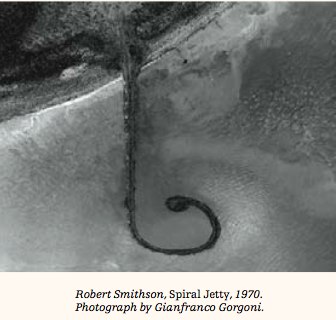
Initially, the jetty was not planned as it appears today. Photographer, Gianfranco Gorgoni who helped document the building of the Spiral Jetty took this shot, which is how Smithson originally imagined it.


Yet, Smithson called Bob Phillips and his crew back, after having "completed" the project, to construct what eventually would become Smithson's most famous work. Phillips's story has recently been covered by the Salt Lake Tribune.

Spiral Jetty is part of the efflorescence and culmination Smithson's conceptual thinking about complexity, change, monument, ownership, energy, and metaphor among many other theories and concepts.

"Spiral Jetty in Red Salt Water," n.d. circa 1970
Image Source

Today, Smithson's jetty has become symbolic of the deep influence the artist has had on contemporary artists and the art world. Home to Smithson's seminal work and one of the most important art pieces in the entire 20th century, Utahns of all ages owe it to themselves to visit Rozel Point. See you there! Check out a clip from Smithson's video about the Spiral Jetty here.